
Natural lung physio · No drugs · No batteries
Breathe deeper. Cough less. Feel lighter.
D-PEP is a pocket-sized lung exerciser that helps shake loose the mucus clogging your chest — and builds stronger breathing muscles every time you use it.
Lightweight & handheld
Drug-free vibration therapy
Designed & made in Australia
Reusable for years
Sound familiar?
That heavy, tight, can't-quite-clear-it feeling.
Years of ageing, pollution, smoking, vaping or a nasty chest infection slowly narrow the airways and let mucus settle in. You feel puffed sooner, cough more, and never quite get a full breath.
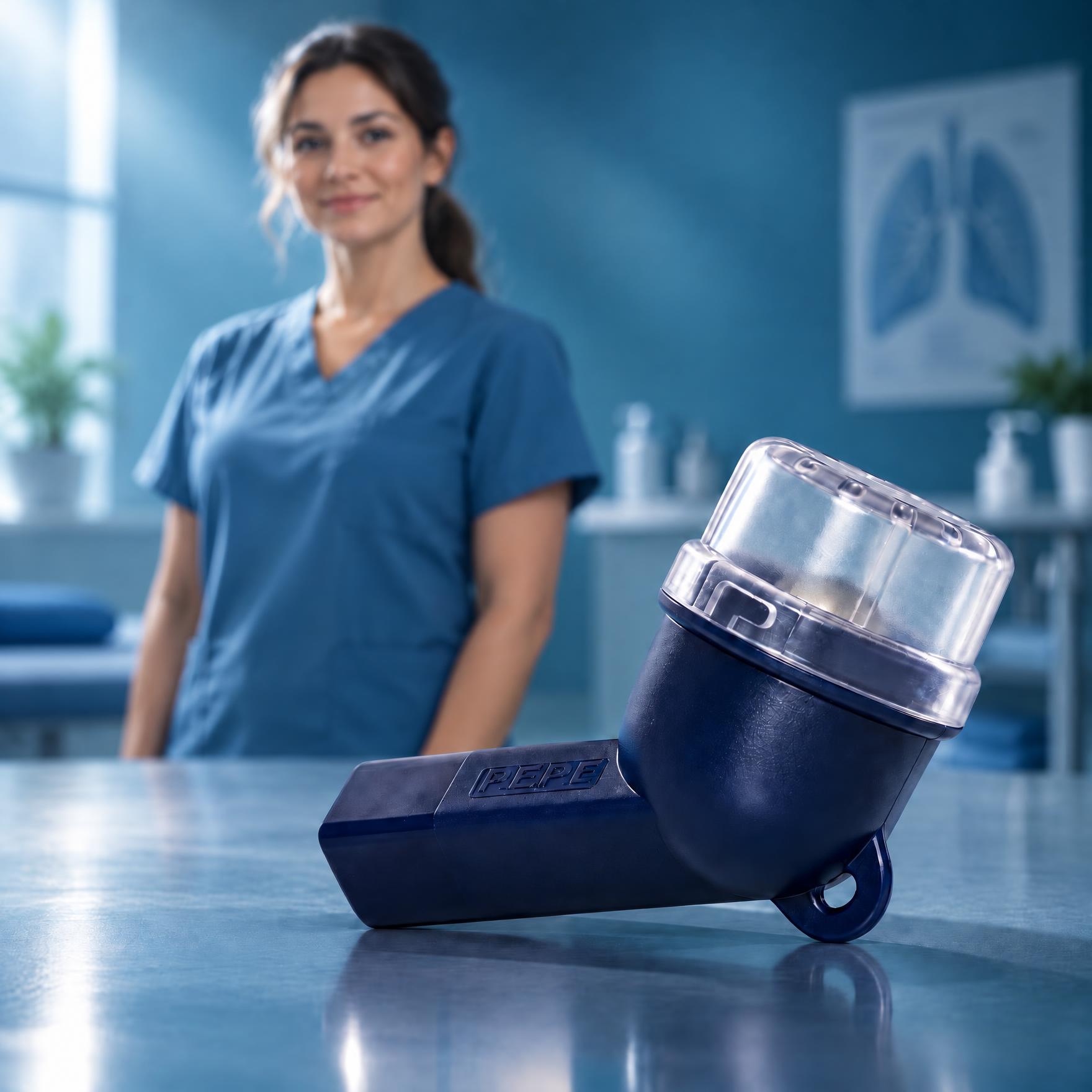
D-PEP uses a technique physiotherapists have trusted for decades — positive expiratory pressure (PEP) — in a simple device you can use on the couch.
Three things happen with every breath out.
Vibrate
A stainless-steel ball dances as you breathe out, sending gentle vibrations through your airways that shake mucus loose.
Hold open
Gentle back-pressure keeps your airways open as you exhale, so mucus doesn't get stuck on the way up.
Clear out
Faster airflow pushes the loosened mucus up to where a simple cough or huff clears it.
The secret is the steel ball. Tilt the device until you feel the strongest buzz in your chest — that's when the vibration matches your body's natural rhythm, giving the best clearing effect.
Straight away
Open up blocked airways
Loosen and clear the mucus that's been building up, so each breath goes deeper.
Over time
Build stronger breathing muscles
Train your diaphragm and rib muscles to pull in more oxygen and push out more carbon dioxide.
Made for anyone who wants easier breathing
PEP therapy is clinically recognised as potentially beneficial for people living with:
Backed by research
A proven design, tested in the lab.
The steel-ball-in-a-cone design behind D-PEP has been studied for decades. A Griffith University report found devices of this design perform just like the Flutter — the best-known clinical device — across a range of breathing speeds and angles. In one early study, people using this style of device cleared significantly more mucus than with postural drainage and coughing alone.
See the research →"His personal commitment to delivering 100% natural lung physio is not about $$$$. Peter is 76 years young, still playing touch rugby… His motto is 'health is wealth'."
Breathing and memory
What the early research says about Alzheimer's
D-PEP is a mucus-clearing device, not a dementia treatment. But the breathing work it asks of you sits in the same research area that has started to look at memory and mood — so here is what is actually known, and what isn't.
48 weeks, 40 people
A daily breathing routine
In a randomised trial of adults aged 50–80 with mild to moderate Alzheimer's, a deep-breathing routine (15 cycles, three times a day) improved scores on the standard memory-and-thinking scale and on behavioural symptoms, compared with usual care alone.
Small trial, published as a conference abstract — promising, not proof.
Read the study ↗"Preliminary"
What a 2026 review concluded
A review of breathing and respiratory training as a way of protecting cognition found only preliminary evidence so far. Most trials were small, used different exercises, and results were inconsistent — it calls for properly designed trials before any conclusions.
Read the review ↗Swallowing & cough
Why the chest matters in dementia
Swallowing difficulties are common in dementia, and chest infections from food or drink going the wrong way are a major risk. A 2025 case report found breathing-muscle training was something a person living with mixed dementia could actually do — feasibility, not benefit.
Read the report ↗What this does not mean
None of these studies used D-PEP. D-PEP is an oscillating positive expiratory pressure device for clearing mucus — it is not a breathing-muscle strengthener, and nothing here suggests it treats, slows or prevents Alzheimer's.
What it may help with is the everyday thing: clearing chest mucus in someone who can't manage chest physiotherapy on their own. Ask a physiotherapist whether that fits your situation.
If you're caring for someone with dementia
Watch for coughing during meals, a wet or gurgly voice, weight loss, or fever with worsening breathing — those can mean food or drink is going down the wrong airway, and they need a health professional, not a device.
Check with their doctor or physiotherapist before starting, sit them upright, stay with them, and stop if they become light-headed or distressed.
Questions, answered
Is it safe? Are there drugs involved?
D-PEP is 100% drug-free. It works purely with your own breath. Feeling a little light-headed at first is normal — just take it easy and don't push too far.
How long does a session take?
Usually 12–20 minutes: three sets of around 15 breaths, with a huff or cough between each set. Your health professional can tailor how often you use it.
How do I clean it?
It pulls apart into four pieces. Wash in warm soapy water, rinse, let it dry completely and click it back together.
Who makes it?
PEPE Australia Pty Ltd in Burleigh Heads, QLD. It's designed and made in Australia and listed on the ARTG (No. 351811).
Your next deep breath could feel very different.
One small device. A few minutes a day. Made right here in Australia.